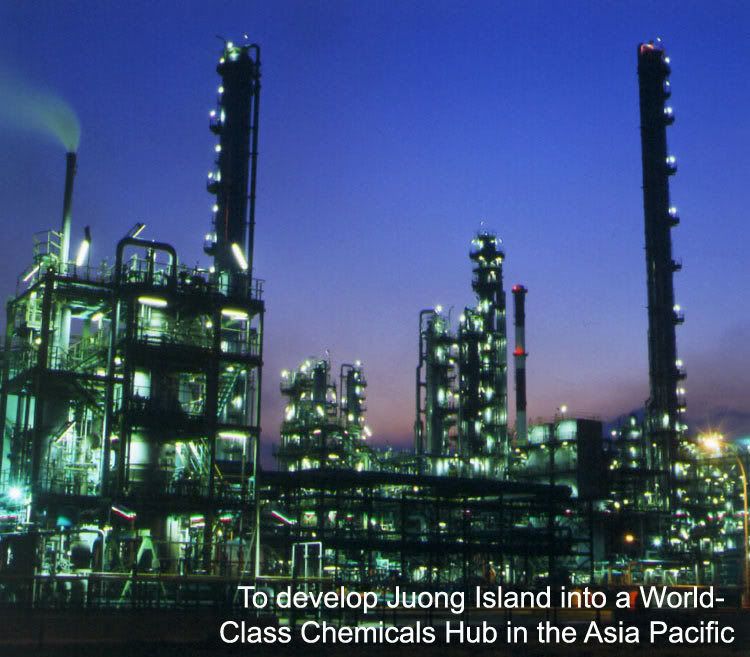
As mentioned above, the reasons for the development of Jurong Island lies heavily with the economy. By building Jurong Island, chemical companies will invest in Singapore, adding money to the country. Singapore’s chemicals industry is a key pillar of our manufacturing sector, contributing 23% to our manufacturing output in 2002. Today, Singapore is recognized as one of the key chemicals hub globally, standing alongside other major hubs such as those located in Houston and Rotterdam. Also, Singapore gets to open a new field of industry and enterprise for her people by providing services to the chemical companies, and also creating more jobs for the people. The development of Jurong Island is emblematic of the Singapore Government's determination to develop the economy so that our people will have rewarding jobs and a higher standard of living. The government has reduced their income tax rates and lowered business costs to continue to build up local businesses and attract foreign investment and multi-nationals to do business here in Singapore. EDB and JTC Corporation have also started to develop a major logistics hub called the Banyan LogisPark on Jurong Island. This will provide integrated logistics support to the rapidly growing number of chemical and petrochemical companies on the Island. The completion of the Chemical and Process Technology Centre on Jurong Island this year represents another major milestone. The Centre caters to pre-employment training for students graduating from our Polytechnics and Institutes of Technical Education as well as to in-employment training for chemical and life sciences companies.
OK, guess you guys are having an info-overload...so to put simply:Social reasons:
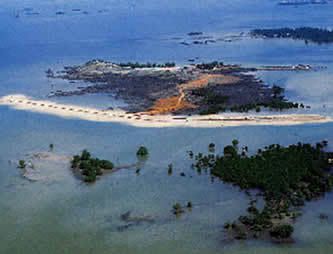
1. The planning of the Jurong Island began with the idea of Synergy where individual islands could be combined into one main landmass for the purpose of building a petrochemical hub.
Economic reasons:1. Singapore chemical industry delivered an encouraging performance in 2003 as the output rose by 23 per cent to $39.1 billion and value-added output (VA) grew from 9 per cent to $5.2 billion. This increase was despite the challenges of rising raw prices and high energy costs faced by the industries globally. Hence, the excellent performance boosted the chemical industry share of manufacturing output over 26 per cent, up from 22.6 per cent in 2002. This strengthens its position as the second largest industry after electronics. Thus, they realised that the development of Jurong Island will improve the economy.
2. The petrochemical output soared by 38 per cent to $12.1 billion and the value-added output surged by 29 per cent to 1.4 billion in 2003. This gave the EDB (Economic Development Board) the confidence to invest and plan out Jurong Island to further boost Singapore’s economy.
3. The combining of seven small islands in one to produce a petrochemical hub makes sense as it would involve making use of Singapore’s largest petroleum base to produce key feedstock for making other petrochemical specialty chemicals and fine chemicals through the cluster development strategy.
4. As there is a strong growth of Asian nations, particularly China, the EDB (Economic Development Board) wanted to enhance Singapore’s position as a regional oil hub to meet the needs of the rapidly expanding energy of Asia. This makes Jurong Island very important as being the regional oil hub will benefit the economy of Singapore tremendously.
5. Most chemical plants has also developed and increased its output by quite a lot in 2003, such as Specialty Chemicals, Mitsui Chemicals and many more.
TADA!!! YAY!..get the point now?